

Foundation Repair in Madison, WI
Foundation problems rarely announce themselves all at once. Usually it starts with a crack that wasn't there last spring, a door that started sticking, or a floor that doesn't feel quite right. By the time most homeowners call us, the problem has been building for a while. The good news is that most foundation issues are fixable. But the window to fix them affordably closes the longer you wait.
DS3 Solutions diagnoses and repairs foundation problems across Madison, Verona, Sun Prairie, Middleton, Monona, Waunakee, Cottage Grove, and all of South Central Wisconsin. We have been doing this work for over 30 years combined. We know what these foundations look like, what fails first, and what actually fixes it.
Request a Free Estimate
We'll get back to you within one business day.
Contact Us
We will get back to you as soon as possible.
Please try again later.
The Conditions Here Are Tough on Foundations
South Central Wisconsin combines three of the worst conditions a foundation can face and they don't take a season off.
The Soil
Clay soils are common throughout Dane County. They hold moisture, expand when wet, and contract when dry. When they expand, they push against your foundation walls. When they shrink back, they pull away and leave gaps that collect the next round of rain. That cycle happens every year, and every year it adds stress to your foundation.
The Freeze-Thaw Cycle
Every Madison winter brings repeated cycles of freezing and thawing. Moisture in the soil surrounding your foundation freezes and expands, pushing laterally against the walls. Over multiple winters, that pressure causes cracking, bowing, and shifting. Homes in clay-heavy soil face a higher risk because clay holds more moisture than sandy soil, giving the freeze cycle more to work with.
Older Homes Are Most Vulnerable
The median home construction year in Madison is 1980, and about 13 percent of homes in the city were built before the 1940s. Neighborhoods like Monona, Middleton, Westmorland, and Cottage Grove have a lot of homes built in the 1950s, 60s, and 70s with concrete block foundations. Block is more porous than poured concrete and the mortar joints are natural weak points. If you own a pre-1985 home in the Madison area and have not had your foundation evaluated, it is worth a look.
The Backfill
When your foundation was poured, the contractor dug out the soil and backfilled it once the walls were up. That backfilled soil is looser and holds water far more readily than the original undisturbed ground. Water collects in the soil directly against your foundation walls, builds pressure, and pushes inward. That is the root cause of most cracking and bowing we see in homes across Madison, Fitchburg, DeForest, and the surrounding area.
What to Watch For in Your Dane County Home Foundation
Foundation damage shows up in patterns. Here are the signs we see most often when we inspect homes across Madison and the surrounding communities.
Horizontal cracks in basement walls. The most serious crack type. In block foundations, a horizontal crack near mid-wall height means the wall is under lateral pressure and may be starting to bow inward. This is not cosmetic and it does not get better on its own.
Stair-step cracks. Diagonal cracks following the mortar joints in a stair-step pattern indicate foundation movement or settlement. Common in block and brick foundations across older Madison neighborhoods.
Vertical cracks. Straight vertical cracks in poured concrete often come from the concrete shrinking as it cured. Usually less urgent, but wide or growing cracks can let water in and should be evaluated.
Bowing or leaning walls. A basement wall that is visibly pushing inward is a structural problem. The longer it moves, the more involved the repair. Call us.
Doors and windows that stick. When a foundation shifts or settles, door and window frames shift with it. Sticking doors or gaps around window frames are worth getting evaluated.
Floors that slope or feel uneven. Settlement in the foundation shows up in the floors above it. A slope you can feel when walking is often a sign something has moved underneath.
Gaps between walls and ceiling or floor. Uneven settlement pulls sections of the structure apart at the joints.
Leaning or cracked chimney. A chimney pulling away from the house or cracking vertically often means the footing below it has settled separately from the main foundation.
What DS3 Solutions Repairs and How
Every foundation problem has a cause. We find it before we fix it. The right repair for a bowing block wall is different from the right repair for a poured concrete crack, which is different from a settling footing. Here is what we do and when each solution applies.
Wall anchors. For bowing or leaning walls, wall anchors are one of the most reliable long-term solutions. A steel plate is installed against the interior wall, a rod runs through the soil to an anchor plate buried in stable ground further out, and the assembly is tightened to stop further movement. In some cases, with periodic tightening over time, wall anchors can gradually pull a bowed wall back toward plumb. We use this on homes in Sun Prairie, Waunakee, and the older neighborhoods on Madison's west side regularly.
Carbon fiber straps. For walls that are bowing but haven't moved significantly, carbon fiber straps bonded to the interior face of the wall provide strong stabilization without excavation. A good option when access around the exterior is limited.
Wall braces. Steel I-beam braces installed floor to ceiling against a bowing wall stop further inward movement immediately. A practical option when the situation needs to be addressed quickly
Wall Stabilization and Repair
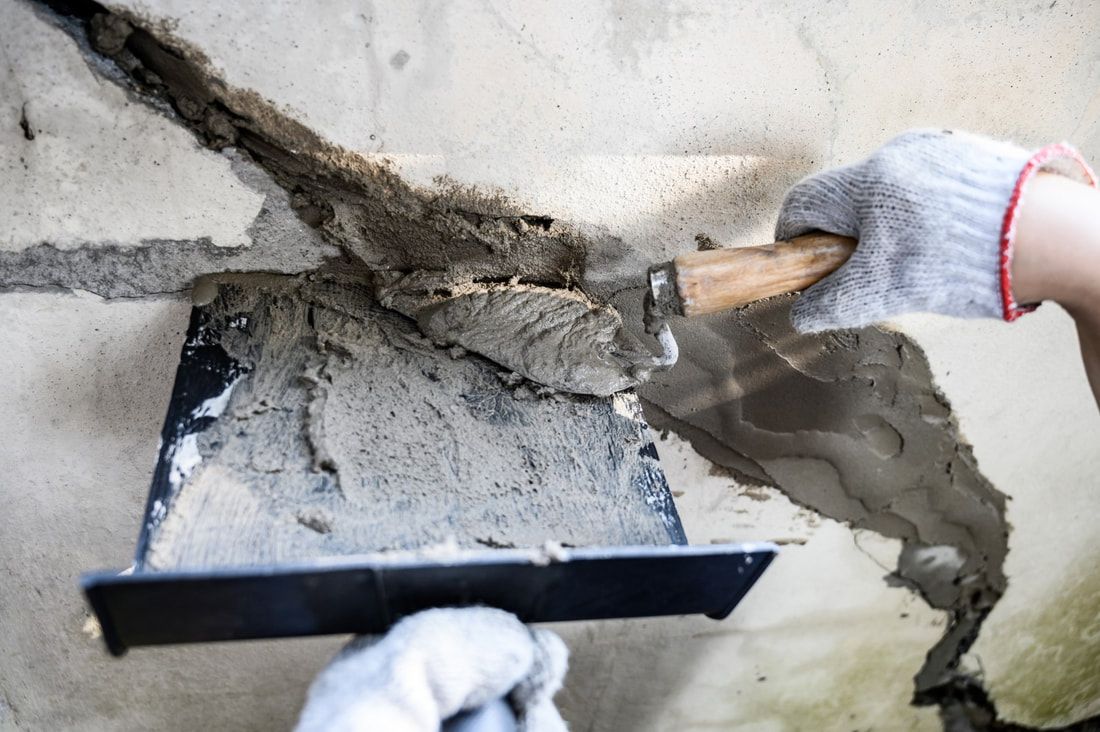
Epoxy crack injection. For structural cracks in poured concrete, epoxy fills the crack under pressure and bonds the two sides back together. The repair often ends up stronger than the surrounding concrete. A permanent fix for the crack, though the drainage or soil conditions causing it should also be addressed.
Polyurethane injection. For active cracks letting water in, polyurethane foam expands inside the crack and creates a flexible waterproof seal. Good for cracks that see seasonal movement.
Block wall repointing and crack repair. For block foundations with cracked or deteriorated mortar joints, repointing restores the wall's integrity. For larger cracks through the block itself, we assess whether repair or stabilization is the right call.
Foundation Crack Repair
Helical piers. Threaded steel shafts driven past the unstable active soil layer down to load-bearing strata. Once in place, they support the foundation and in many cases allow for partial lifting back toward original elevation. One of the most reliable long-term solutions for settlement.
Push piers. Hydraulic push piers are driven into the ground using the weight of the structure as resistance, stopping when they reach stable soil or bedrock. Used in similar situations to helical piers depending on soil conditions and site access.
Foundation Settlement and Piering
When a foundation is settling unevenly into the ground, the fix requires getting load back onto stable soil. Piers are the standard solution.
Sometimes the foundation itself is not the only problem. Water pooling against the foundation because the grade slopes the wrong way, gutters discharging too close to the wall, or poor drainage at the downspouts can all create or worsen foundation damage over time. DS3 handles grade correction and drainage as part of a complete repair approach, because fixing the wall without fixing the water source is a short-term answer.
Grade Correction and Drainage
Straight Talk From a Local Contractor
The foundation repair industry has a reputation for high-pressure sales and oversized proposals. We have heard that from homeowners across Madison, Verona, and Stoughton who called us after getting a quote somewhere else that felt off. Our approach is simple. We come out, look at the problem, and tell you what we see, including if it is something minor that just needs to be monitored rather than repaired right now.
Honest inspection first.
You know what is happening and why before we propose any work.
Licensed and Insured
Wisconsin Contractor License 052300539-DC. Every job fully insured.
Written warranty on every repair.
We stand behind the work.
30-plus years of combined experience.
Our crews have repaired foundations in Madison, Middleton, Oregon, Lake Mills, and across South Central Wisconsin. We know the soil and the building stock in this area.
Commercial capability.
Four active crews. We handle single-family homes and large commercial properties, including property management accounts that trust us with multiple sites.
No upselling.
If it does not need to be fixed right now, we will tell you that.
Foundation Repair Across Dane County and Beyond
DS3 Solutions is based in DeForest and travels up to 100 miles for the right job. We serve the entire Madison metro and surrounding communities.
Madison
Sun Prairie
Waunakee
Middleton
Verona
Fitchburg
Monona
Mount Horeb
McFarland
DeForest
Stoughton
Windsor
Marshall
Cottage Grove
Cross Plains
Brooklyn
Belleville
Cambridge
Lake Mills
Evansville
Prairie du Sac
Blue Mounds
Black Earth
Mazomanie
Edgerton
Sauk City
Lodi
Deerfield
Oregon
Mazomanie
Dane and surrounding areas.
Foundation Repair Questions, Answered Straight
How do I know if my foundation problem is serious?
Horizontal cracks in block walls, bowing or moving walls, and stair-step cracks that are growing are what concern us most. Any crack that is getting bigger or any wall that is moving needs professional eyes on it soon. A free inspection gives you a real answer.
How much does foundation repair cost in Madison, WI?
Depends on what is wrong and how far along it is. A crack injection can be a few hundred dollars. Wall anchor systems or piering for settlement can run several thousand to $15,000 or more depending on scope. We won't know until we see it. Free written estimates with no obligation.
Can foundation problems be fixed permanently?
Most of our repairs are designed to be long-term solutions. Wall anchors, carbon fiber straps, and piers are engineered for permanent stabilization, all backed with a written warranty. Addressing the drainage or grading contributing to the problem is part of doing it right.
How long does foundation repair take?
Most residential repairs are done in one to three days. Larger jobs involving multiple piers or significant excavation take longer. We give you a realistic timeline before we start and we stick to it.
Will I need to leave my home during repairs?
Almost never. Most repairs are done from inside the basement with minimal disruption. We will walk you through what to expect before we start.
My house is older. Is it too far gone to repair?
Rarely. We have repaired block foundations in Monona and Middleton that have been moving for years and brought them back to solid, stable condition. Earlier is always easier, but most problems we see are still very fixable. The inspection will tell you where things stand.
Do you work on commercial foundations?
Yes. We serve commercial clients including property management companies throughout the Madison area. Four active crews means we can handle larger jobs without long lead times.
Will foundation repair affect my home's value?
A documented, warranted repair removes a serious liability. Inspectors flag active foundation movement and it stops sales in their tracks. Getting it fixed and documented before listing is almost always the smarter move.
What is the difference between foundation repair and waterproofing?
Foundation repair addresses structural problems like cracking, bowing, and settling. Waterproofing addresses water intrusion. They often overlap because water is frequently a contributing cause of structural damage. DS3 handles both and we will tell you honestly which one your situation calls for.
Related Services
Start With a Free Inspection
If you are seeing cracks, wall movement, sticking doors, or anything else that makes you wonder about your foundation, give us a call. We will come to your home, evaluate what is actually happening, and give you a written estimate. No pressure. No overselling.
Request a Free Estimate
We'll get back to you within one business day.
Contact Us
We will get back to you as soon as possible.
Please try again later.